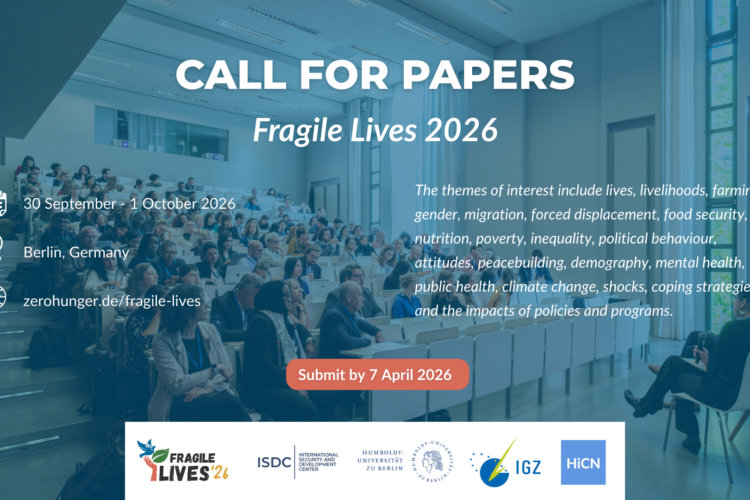
Call for Papers: Fragile Lives 2026
30 September – 1 October 2026 in Berlin, Germany Fragile Lives convenes international experts from academia, policy, and practice on the use of rigorous evidence […]
Read More
Read from a series of more than 400 working papers
Farmer–herder conflicts across West Africa are conventionally attributed to competition over land and water. Yet, identity – ethnic difference and outsider status – features prominently […]
Polling Place Matters: How Voting Location Influences Election Fraud
Robert Gonzalez, Tannishtha Ghosh, Kelly Lifchez
Research on the determinants of election fraud typically focuses on conventional factors such as election monitoring, legal punishments, and voter education. This paper examines an […]
Mobile Phones and Gender Norms: Evidence from Afghanistan
Robert Gonzalez, Seunghun Chung, Ahmad Shah Mobariz
This paper examines the impact of mobile phone expansion on gender norms in Afghanistan. We combine cell tower data from the country’s largest operator with […]
The deployment of military personnel in response to urban crime has become increasingly salient in the United States. Yet the effectiveness and efficiency of such […]
An Analytical Framework for Measuring Food System Resilience in Fragile Situations
Francisca Castro, Tilman Brück, Wolfgang Stojetz, Elena Serfilippi, Alessandra Garbero, Timur Cipa
This paper introduces a comprehensive analytical framework for measuring food system resilience in fragile situations, integrating the concepts of resilience and fragility. Our proposed framework […]
Piero Ronzani, Wolfgang Stojetz, Sarah Fenzl, Siwar Hakim
Climate vulnerability assessments have traditionally relied on macro-level indices and physical exposure models, overlooking household-level heterogeneity and the behavioral determinants of vulnerability. To fill this […]
Call for papers, events, news and more